May 2024
Red Tide Viruses
17/05/24 18:34
Elucidation of the Host Recognition Mechanisms of Natural Marine Viruses Governing the Collapse of Harmful Algal Blooms
Red tides, caused by the massive proliferation of microalgae, often cause catastrophic damage to the fishing industry. Our collaborators, the Nagasaki group, have discovered and isolated numerous "natural enemy" viruses from the natural environment that can exterminate red tides within a very short period. They are proposing prevention and control technologies utilizing these viruses.
These viruses exhibit extremely high host specificity. It is anticipated that their utilization will pave the way for the selective elimination of target harmful algae without disrupting the surrounding ecosystem.
This high infection specificity is based on specific interactions between the virion (virus particle) and host surface structures . To understand these details, structural analysis of both the virus particle and the host receptor at the atomic level is indispensable. Furthermore, a diverse group of enzymes is involved in the lysis of host cells. We believe that elucidating the three-dimensional structures of the key proteins governing the host collapse process will lead to the development of control technologies for harmful algae.
In this study, we target viruses that specifically infect and lyse harmful red tide-causing plankton, as well as proteins that play key functional roles during the infection process, with the aim of elucidating their infection and lysis mechanisms.
Red tides, caused by the massive proliferation of microalgae, often cause catastrophic damage to the fishing industry. Our collaborators, the Nagasaki group, have discovered and isolated numerous "natural enemy" viruses from the natural environment that can exterminate red tides within a very short period. They are proposing prevention and control technologies utilizing these viruses.
These viruses exhibit extremely high host specificity. It is anticipated that their utilization will pave the way for the selective elimination of target harmful algae without disrupting the surrounding ecosystem.
This high infection specificity is based on specific interactions between the virion (virus particle) and host surface structures . To understand these details, structural analysis of both the virus particle and the host receptor at the atomic level is indispensable. Furthermore, a diverse group of enzymes is involved in the lysis of host cells. We believe that elucidating the three-dimensional structures of the key proteins governing the host collapse process will lead to the development of control technologies for harmful algae.
In this study, we target viruses that specifically infect and lyse harmful red tide-causing plankton, as well as proteins that play key functional roles during the infection process, with the aim of elucidating their infection and lysis mechanisms.
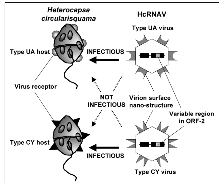
HcRNAV, a virus that infects the red tide-causing plankton Heterocapsa, establishes infection by distinguishing even between different host strains. (Courtesy of the Keizo Nagasaki Group, Fisheries Research Agency)

Electron Micrograph of HcRNAV
We have successfully cultured the host red tide plankton in the laboratory and amplified the virus by infecting it with HcRNAV.
This research project was launched in FY2008. Although we are steadily accumulating results, we refrain from posting the details here as much of the data remains unpublished.